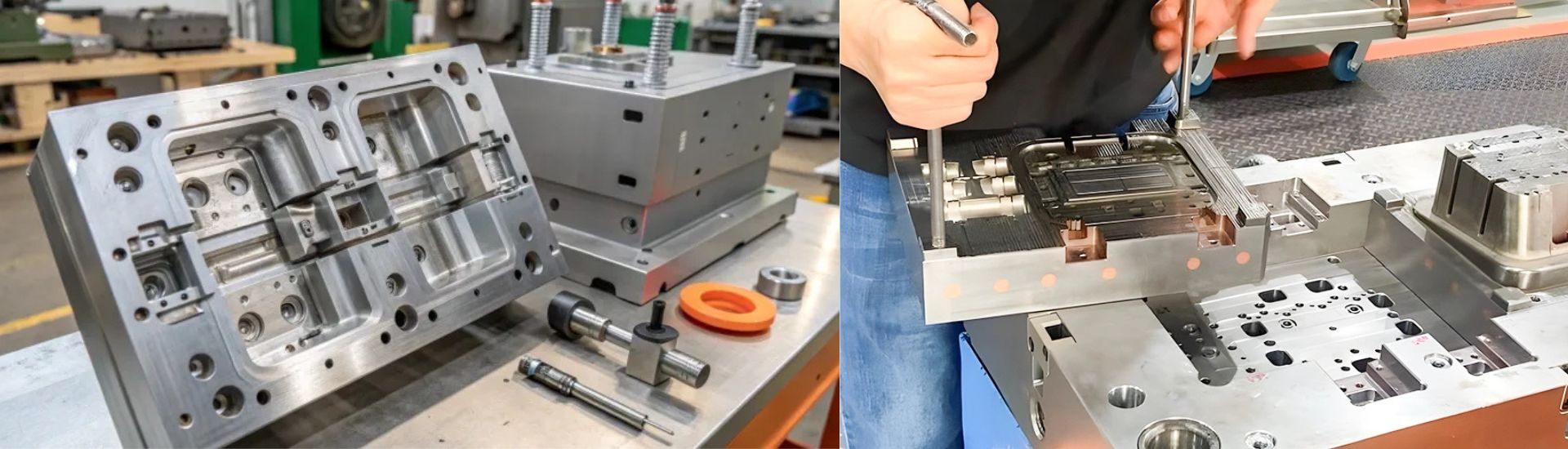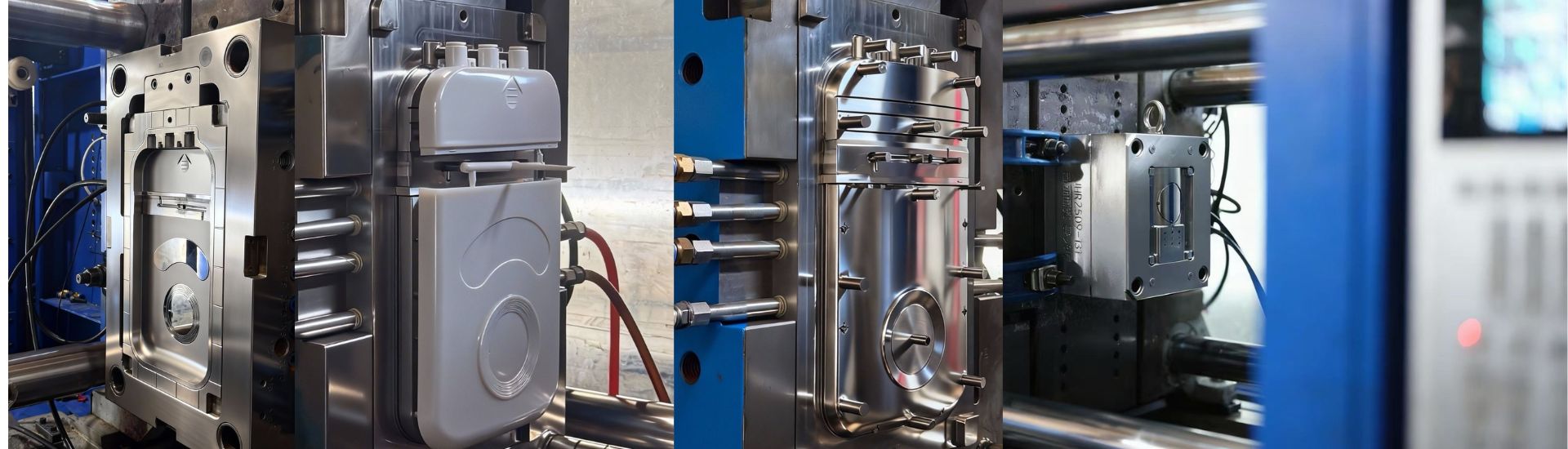


Picking the wrong plastic resin is one of the most expensive mistakes in injection molding. Material picks mold steel, gate design, cooling layout, and scrap rate — long before the first part comes off the tool. In this 2026 guide, we break down the five engineering resins that cover roughly 80% of commercial injection molded parts: PP, ABS, PC, PA (nylon), and POM (acetal). For each one, you will get the honest pros and cons, the typical applications, the tooling pitfalls, and the alternatives worth knowing. If you are specifying a new part, sending an RFQ, or trying to reduce scrap on an existing tool, this is the framework your molder wishes you used on day one.
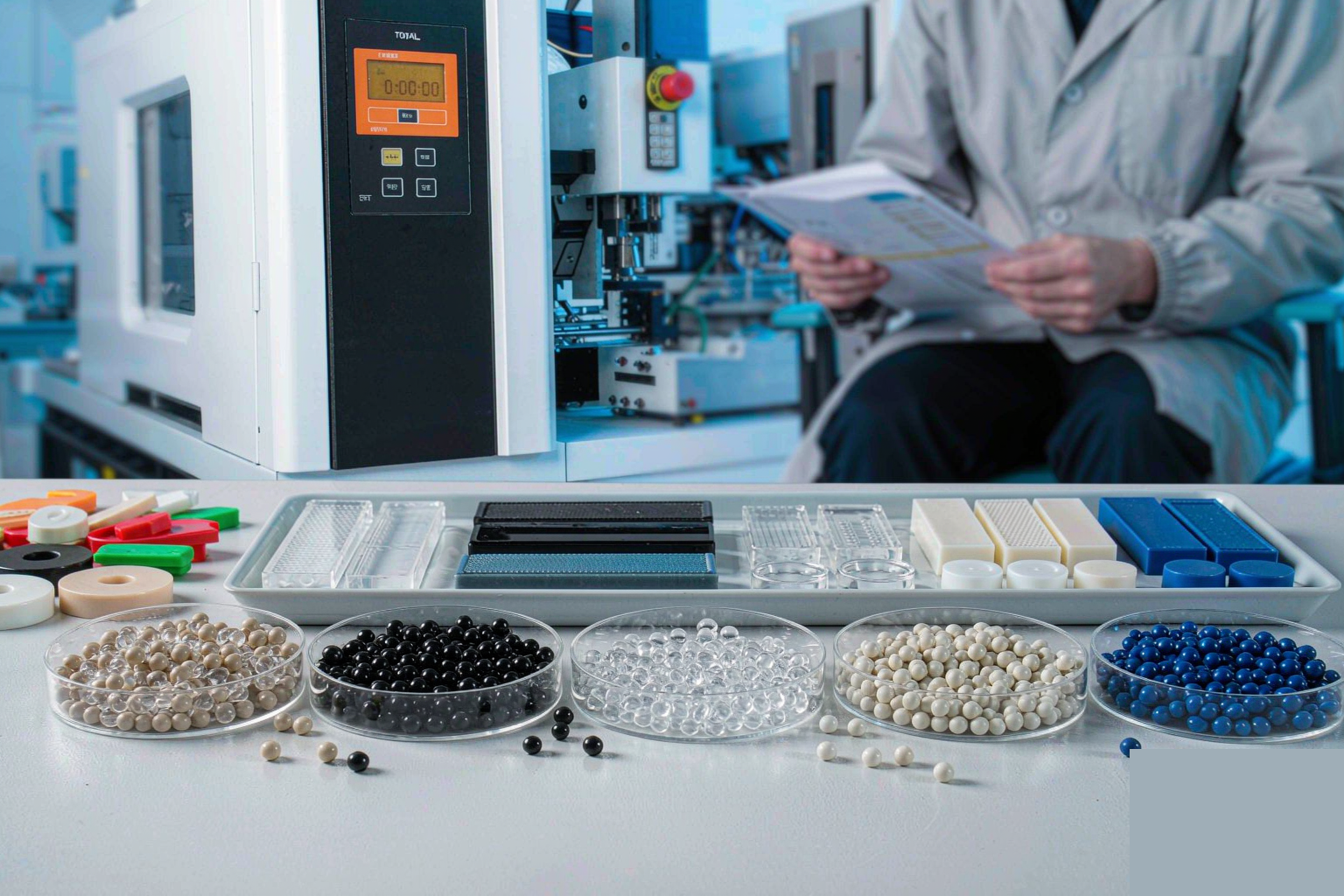
Why Material Choice Drives Tool Cost, Not Just Part Cost
Many buyers treat resin as a line item and tooling as a separate decision. In practice, the resin picks the mold steel, the gate type, the cooling layout, and the cycle time — all of which move tool cost far more than part geometry alone.
- PP can run in P20 or pre-hardened H13 tools with water cooling.
- PC and glass-filled PA demand H13 or S136 cores, hardened slides, and beryllium-copper inserts in the corners.
- POM releases corrosive formaldehyde during processing, so vented cavities and corrosion-resistant steel are not optional.
- ABS sits comfortably in the middle of every requirement, which is why it dominates consumer enclosures.
Bottom line: if you change material mid-tool, expect 15–40% rework on the steel and 2–4 weeks added lead time. The cheapest resin to mold is rarely the cheapest part to ship.
PP (Polypropylene) — The Low-Cost, Chemical-Resistant Workhorse
Polypropylene is the cheapest of the five and the easiest to process. It has a low density (0.90 g/cm³), good chemical resistance, and excellent hinge fatigue life — the property that makes “living hinge” caps and closures possible. Cycle times are typically 20–30% shorter than ABS, and demolding is forgiving.
Best for: Food containers, caps and closures, thin-wall packaging, dishwasher-safe housewares, battery cases, automotive interior trim, living-hinge lids, syringe bodies (medical grade), dishwasher tubs.
Watch out for:
- Poor UV resistance — outdoor parts need UV-stabilized grades, paint, or a cap layer.
- Brittle below 0 °C — cold-chain packaging typically uses a PP copolymer or impact copolymer.
- High shrinkage (1.5–2.0%) — plan for warpage control and dimensional variation.
- Notch-sensitive — keep radii above 0.3R wherever possible.
- Difficult to bond or paint without surface treatment (corona, flame, plasma).
ABS — The Balanced All-Rounder
ABS (Acrylonitrile Butadiene Styrene) gives you a balanced mix of toughness, surface finish, and cost. It machines well for CNC prototypes, bonds to inserts, and chrome-plates cleanly — which is why it dominates consumer electronics enclosures, power tool bodies, and toys.
Best for: TV and monitor housings, power tool bodies, keyboard frames, luggage shells, automotive interior trim, toys, computer mice, 3D printer enclosures, plumbing fittings (gray ABS).
Watch out for:
- Poor UV and weather resistance — outdoor enclosures need ASA, AES, or a UV-stabilized ABS grade.
- Yellowing under heat — automotive interior specs frequently call for low-yellowing grades.
- Moderate chemical resistance — avoid ketones, esters, and strong acids (ABS dissolves in acetone).
- High gloss surfaces show knit lines and weld lines easily — plan gate locations around visible faces.
PC (Polycarbonate) — Strong, Clear, and Heat-Resistant
Polycarbonate delivers the highest impact strength of any common injection molding resin (notched Izod ~600–800 J/m) plus optical clarity and a 135 °C heat deflection temperature. It is the default for safety glasses, automotive headlamp lenses, and medical device housings.
Best for: Safety helmets, LED light covers, automotive headlamp lenses, medical device enclosures, clear water bottles, electrical junction boxes, riot shields, bullet-resistant glazing (laminated).
Watch out for:
- Stress cracking — design radii generously (≥0.5× wall thickness), anneal machined parts.
- Hydrolysis at high humidity and temperature — black or glass-filled grades are more stable.
- High mold temperatures (80–120 °C) require heated tools and oil or water heaters, raising tooling cost and cycle time.
- Yellowing under UV — outdoor PC needs a UV-stabilized cap or hard coat.
- Sensitive to notches and chemicals — avoid chlorinated solvents and aromatic hydrocarbons.
PA (Nylon 6 & 66) — Tough, Wear-Resistant, but Moisture-Sensitive
Polyamide (nylon) is the workhorse for mechanical parts. PA66 has higher strength, stiffness, and heat resistance than PA6; PA6 is cheaper and easier to mold with better surface finish. Both absorb water (1–3% by weight at equilibrium), which acts as a plasticizer — improving toughness but changing dimensions. Always design and inspect to conditioned, not “as-molded” dimensions.
Best for: Gears, bearings, bushings, fasteners, cable ties, automotive under-hood parts, power tool housings (glass-filled), safety helmets (replacing PC where cost matters), conveyor links, zip ties.
Watch out for:
- Dimensional change with moisture — design parts to conditioned, not as-molded, drawing.
- Glass-filled grades are abrasive — use S136 or H13 with nitrided or TiN-coated cavities, and hardened screws.
- Flash tendency — vent cavities generously and hold tight tolerance on clamp tonnage.
- High mold and melt temperatures — cycle time is longer than PP/ABS.
- PA6 vs PA66: choose PA66 for heat and stiffness, PA6 for surface finish and cost.
POM (Acetal / Delrin) — Precision, Low Friction, Stiff
Polyoxymethylene (POM, also called acetal; Delrin is DuPont’s homopolymer trade name) is the default for precision gears and snap-fit assemblies. Low friction, high stiffness, excellent fatigue resistance, and very low moisture pickup make it the easiest material for tight-tolerance moving parts. POM is the resin to specify when a plastic part has to do the job of a metal one.
Best for: Zip fasteners, fuel system components, gears, conveyor links, window hardware, fasteners, buckles, watch housings, insulin pen components (medical grade), furniture hinges.
Watch out for:
- Formaldehyde release during processing requires corrosion-resistant mold steel (S136, Stavax) and proper venting to prevent rust and pitting.
- Notch sensitivity — keep radii above 0.3R wherever possible.
- Poor UV resistance — black or UV-stabilized grades for outdoor use.
- Centerline porosity in thick sections (>6 mm) — switch to a copolymer grade (POM-H) or hold wall thickness uniform.
- Avoid contact with strong acids and oxidizers.
Quick Reference: PP vs ABS vs PC vs PA vs POM
Numbers below are typical for general-purpose injection grades; filled and high-flow variants move outside these ranges. Prices are 2026 indicative figures for 1–5 ton lots.
| Property | PP | ABS | PC | PA66 (GF30) | POM |
|---|---|---|---|---|---|
| Density (g/cm³) | 0.90 | 1.04 | 1.20 | 1.38 | 1.41 |
| Tensile strength (MPa) | 30–40 | 40–50 | 60–70 | 150–180 | 60–70 |
| Notched Izod (J/m) | 50–100 | 150–250 | 600–800 | 100–150 | 60–100 |
| HDT @ 0.45 MPa (°C) | 100 | 100 | 135 | 250 | 160 |
| Shrinkage (%) | 1.5–2.0 | 0.4–0.7 | 0.5–0.7 | 0.3–0.6 (flow) | 1.8–2.5 |
| Mold temp (°C) | 20–80 | 40–80 | 80–120 | 80–110 | 80–110 |
| Melt temp (°C) | 200–260 | 220–260 | 280–320 | 270–290 | 190–210 |
| Cost (USD/kg, 2026) | 1.2–1.8 | 2.0–2.6 | 3.0–4.0 | 4.0–5.5 | 2.8–3.8 |
| Tool steel minimum | P20 / 2738 | P20 / 2738 | H13 / S136 | H13 / S136 (nitrided) | S136 / Stavax |
Other Materials Worth Knowing
These five resins cover most commercial parts, but several deserve a quick callout:
- PMMA (acrylic): Optical clarity for light guides and lenses, brittle, scratches easily.
- PBT, PET: Dimensionally stable, used in automotive connectors and electrical housings.
- PPS, PPA, PEEK: High-end engineering plastics for automotive under-hood, aerospace, semiconductor.
- TPE / TPU: Soft-touch overmolding on rigid substrates, two-shot molding for grips and seals.
- Glass-filled PP: Higher stiffness at low cost, but warpage control is harder and tool wear is real.
How to Specify Material in Your RFQ
A clear material callout saves a round of questions and prevents quoting the wrong grade. For each part, include:
- Resin family — e.g., PP homopolymer, ABS injection grade, PC medium-flow.
- Specific grade or approved equivalent — e.g., “SABIC PP 570P or equivalent.”
- Critical properties — impact, HDT, UV, FDA / food contact, flame rating (UL94).
- Color — natural, black, RAL/Pantone match, or masterbatch with let-down ratio.
- Recycled content — PCR-PP / PCR-ABS is increasingly available; specify % if needed.
- Performance target — operating temperature range, chemical exposure, load-bearing vs cosmetic.
- Secondary operations — painting, plating, insert molding, ultrasonic welding.
If you are still in design phase, send your STEP file plus the application context. A short call usually lands the resin in one round.
Get a Free DFM Review and 12-Hour Quote
Choosing the right resin is the first $5,000 decision on a new tool. Get it wrong and you pay again in steel rework, longer cycle times, and warranty claims. Send your STEP or IGES file plus your application to D-TOP MOLD and you will get a written DFM review and a transparent injection molding quote within 12 hours — including the recommended resin, mold steel, gate strategy, and realistic cycle time. Two-week tooling lead times, T1 sample within 5 days after DFM approval.