


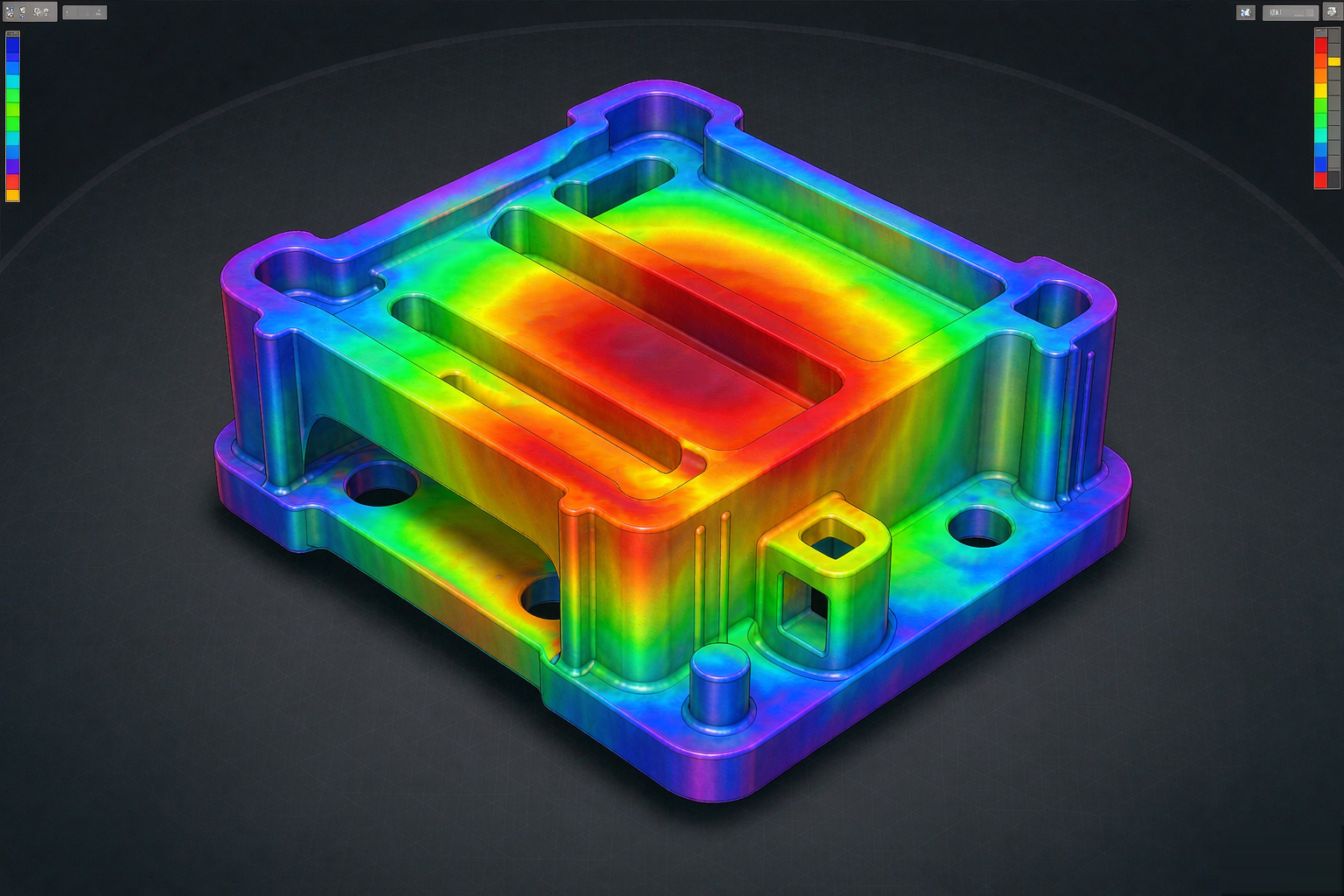
What Is Mold Flow Analysis?
Mold flow analysis is a simulation process that predicts how molten plastic fills, packs and cools inside a mold cavity — before tooling is manufactured. Instead of discovering filling problems during the first trial, you see them on screen while changes still cost nothing: move a gate, thicken a rib, add a vent, rebalance a runner — all in software, all before steel is cut.
For complex or high-value parts, mold flow analysis is the cheapest engineering you will ever buy: it converts trial-and-error on the molding floor into decisions made at the design table.
What Mold Flow Analysis Can Predict
- Filling patterns — how the melt front advances and whether the cavity fills evenly; imbalance means dimensional variation between cavities and inconsistent quality
- Weld lines — where flow fronts meet; the simulation shows their position and predicted strength so cosmetic and structural risks are visible early
- Air traps — areas where trapped air causes short shots or diesel burns, solved with vents or gate changes before the mold exists
- Pressure requirements — injection pressure and clamping force, which decide the machine size and whether the design is even moldable
- Shrinkage and warpage — predicted dimensional deviation after cooling, the single most valuable output for tight-tolerance parts
- Cooling behavior — hot spots that lengthen cycle time and drive warp, fixed in the cooling layout rather than on the molding floor
How Mold Flow Analysis Improves Your Mold
By running the simulation before cutting steel, we optimize gate locations, runner design and cooling layout, and confirm material and process settings. The practical results:
- Fewer mold trials — first trials land closer to final parts
- Shorter overall tooling lead time, because correction loops shrink
- Lower risk of costly steel rework after the mold is built
- Dimensional confidence for precision injection molding programs before the first shot
When We Recommend Mold Flow Analysis
Not every part needs a full simulation — simple, thick-walled parts in forgiving materials usually mold fine without it. We recommend mold flow analysis when:
- Geometry is complex, with varying wall thickness or long flow paths
- Parts are thin-wall, where filling windows are narrow
- Molds are large, multi-cavity or family tools
- Tolerances are tight and warpage is the main risk
- Appearance is critical — weld lines and flow marks must land where they cannot be seen
- The application is medical, automotive or otherwise high-value, where a failed trial costs more than the analysis ever will
Our recommendation is honest: if the simulation will not change any decision, we say so and you save the cost. The methodology behind these checks is the same one we apply in our DFM checklist.
What You Receive from Us
- A written analysis report — filling, weld lines, air traps, pressure and warp results, in plain engineering language
- Specific recommendations — gate position, runner balance, venting, cooling and wall-thickness changes, each tied to a predicted result
- A review call — we walk your engineers through the findings and agree what changes before tooling starts
Mold Flow Analysis at D-top Mould
D-top Mould provides mold flow analysis as part of our DFM and tooling service. The analysis is reviewed together with your part design and material data, and the results guide gate, runner, cooling and process decisions before the mold is manufactured — then validated again on trial parts, so the simulation and the steel agree. For complex parts it pairs naturally with our prototype tooling service: simulate first, confirm in soft steel, then commit to production tooling.
Get Mold Flow Analysis with Your 12-Hour Quote
Send your 3D model, the intended plastic material, expected annual volume and any specific quality or appearance requirements. Our engineering team reviews the project and responds with a quotation within 12 hours — including our recommendation on whether mold flow analysis will pay for itself on your part.