


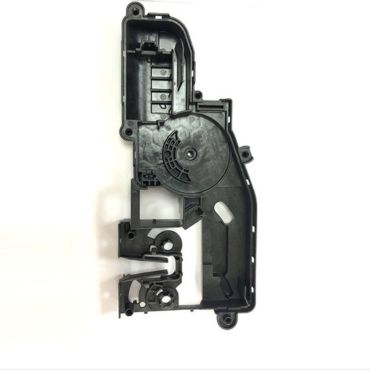
ABS Injection Molding Services
D-top Mould provides custom ABS injection molding for parts that need a good balance of impact resistance, stiffness and surface finish. ABS is one of the most widely used thermoplastics and is well suited to housings, enclosures and consumer products.
Why Choose ABS for Your Part
- Good impact resistance — tough enough for housings and protective parts
- Excellent surface finish — easy to polish, paint or texture
- Good dimensional stability — consistent, accurate parts
- Cost-effective — a versatile, economical engineering plastic
ABS Molding Applications
- Electronic and appliance housings
- Automotive interior trim
- Consumer product enclosures
- Protective covers and casings
- Custom structural components
ABS Material and Design Considerations
ABS offers good toughness and surface quality, with moderate chemical and heat resistance. During DFM we review wall thickness, draft angles, gate location and surface finish requirements to optimize part quality and moldability. Flame-retardant and high-impact ABS grades are also available where required.
ABS Mold Manufacturing at D-top Mould
D-top Mould designs and builds ABS injection molds for prototype and production volumes. Our process includes DFM review, mold flow analysis where needed, careful surface finish control and trial validation before mold shipment.
ABS Injection Molding FAQ
Q: Is ABS good for injection molding?
A: Yes — ABS is one of the most moldable thermoplastics, with a good balance of impact resistance, surface finish and dimensional stability. It is a standard choice for housings, enclosures and consumer products.
Q: What is the difference between ABS and nylon (PA)?
A: ABS gives a better surface finish and lower cost with good impact resistance; nylon offers higher strength, wear and heat resistance for load-bearing mechanical parts. Choose ABS for housings, nylon for structural or moving parts.
Q: How heat-resistant is ABS?
A: Standard ABS is typically rated for about 80–100°C continuous use. For higher heat, consider PC/ABS blends or a heat-resistant grade.
Related Materials
ABS pairs well with other engineering resins. Compare nylon (PA) injection molding for wear-resistant mechanical parts, POM (acetal) injection molding for gears and precision components, and our plastic material selection guide.
What We Need for a Quote
Send your 2D or 3D drawings, the ABS grade you prefer, expected annual volume, color and surface finish requirements. Our engineering team will respond with a quotation within 12 hours.