


What Is Insert Molding?
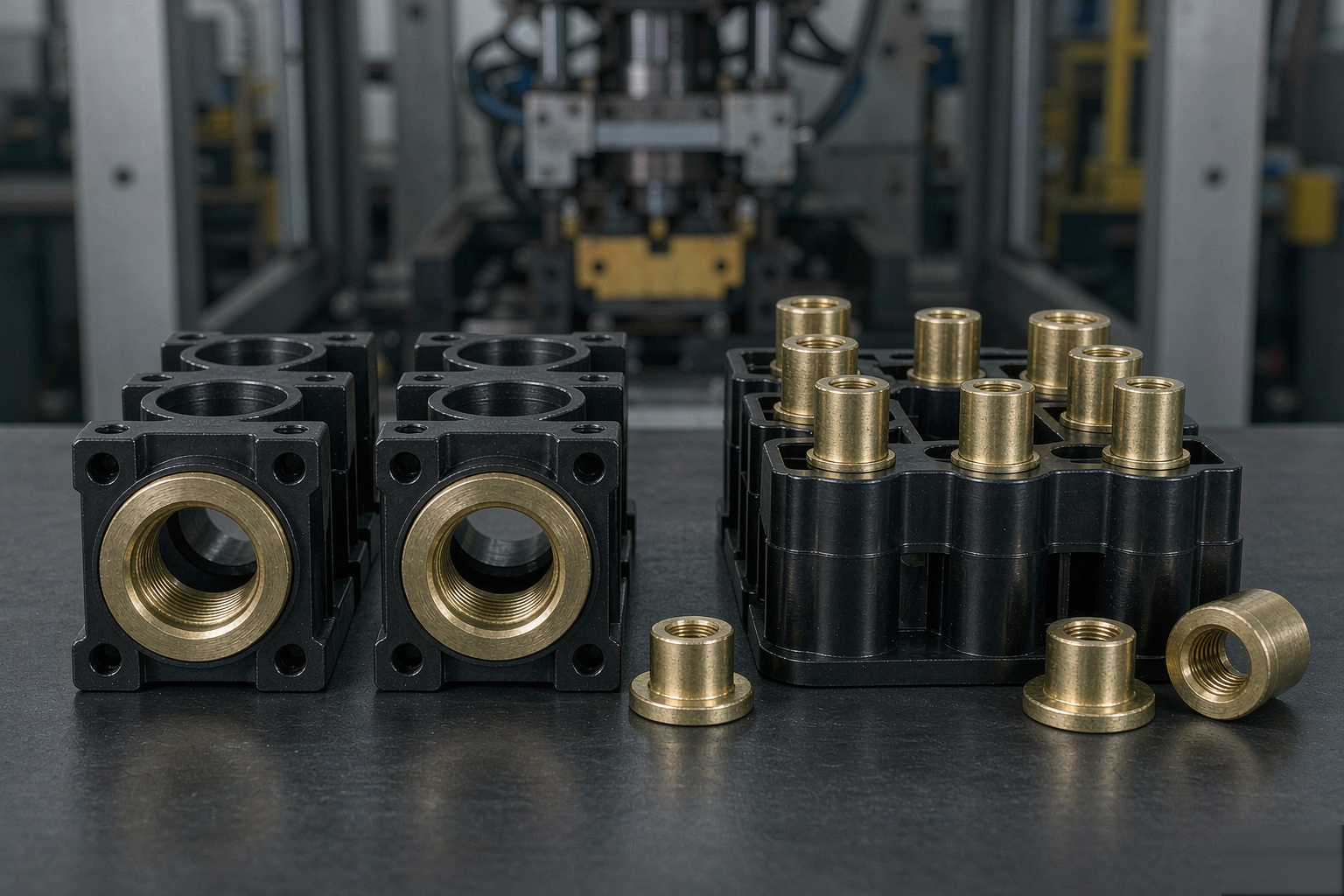
Insert molding is a process in which metal components — threaded inserts, bushings, pins, contacts or stamped parts — are placed into the mold cavity before plastic is injected around them. The result is a single part that combines the strength and thread performance of metal with the design freedom and weight advantage of plastic, eliminating secondary assembly steps entirely.
Where a glued or heat-staked insert can loosen over time, an insert molded into the part is locked in permanently — which is why insert molding dominates in load-bearing fastening points, electrical contacts and sealing applications.
How Insert Molding Works
- Insert preparation — inserts are cleaned, and where needed pre-heated, to improve bonding and reduce stress around the plastic.
- Insert loading — inserts are loaded into the mold by hand, by fixture, or by robot, with position verified before every shot.
- Injection — plastic flows around the insert and encapsulates it, locking it mechanically (and sometimes chemically) into the part.
- Verification — insert position, pull-out resistance and encapsulation quality are checked on trial and sampled in production.
Benefits of Insert Molding
- Reduced assembly — metal components are encapsulated during molding, removing separate insertion, heat-staking or ultrasonic steps.
- Stronger joints — the insert is locked mechanically within the plastic for a connection that outlasts press-fits and adhesives.
- Improved reliability — fewer assembly steps mean fewer potential failure points and less handling damage.
- Design consolidation — multiple functions — fastening, conductivity, reinforcement — combine into one molded component.
- Lower total cost at volume — molding time replaces assembly labor.
Common Insert Molding Applications
- Threaded inserts for fastening — brass, stainless steel and aluminum inserts in housings and covers
- Electrical connectors and terminals — pins and contacts encapsulated with precise positioning
- Bushings, sleeves and standoffs in plastic housings and brackets
- Medical and surgical instrument components
- Automotive electrical and sensor housings — see our automotive injection molding service
Inserts and Materials We Work With
| Insert Material | Typical Insert | Paired Plastics |
|---|---|---|
| Brass | Threaded inserts, knurled bushings | PA, POM, ABS |
| Stainless steel | Pins, contacts, shafts | PA, PBT, PC |
| Aluminum | Heat-set bosses, structural parts | PA-GF, PP-GF |
| Steel stampings | Terminals, contact plates | PBT, PA, PC |
Insert placement, mold protection and cycle time are reviewed during DFM to protect the mold and ensure consistent insert positioning — a misplaced insert damages steel, so loading method and mold protection sensors are engineered in from the start.
Insert Loading: Manual, Fixture or Robot
Loading method decides both cost and consistency. Low volumes run economically with manual loading into locating fixtures; medium volumes use dedicated fixtures that make wrong placement impossible; high volumes justify robotic loading — which is how our own production cells keep insert position identical across millions of cycles. We recommend the method that matches your volume, not the one that pads the quote.
Insert Molding vs Secondary Insertion
| Approach | Best For | Watch-outs |
|---|---|---|
| Insert molding | Load-bearing, high-reliability fastening points | Insert loading adds cycle time |
| Heat-staking / ultrasonic | Low volumes, design changes expected | Extra assembly step, looser alignment |
| Press-fit | Non-critical, prototype builds | Can loosen under load or heat |
Insert Molding at D-top Mould
D-top Mould designs and builds insert molding tools for prototype and production volumes. Our process covers DFM review, insert fixture design, mold protection sensors, and trial validation to ensure inserts are correctly positioned and securely encapsulated in every shot. We support both new insert tooling and converting existing assembled parts to insert-molded designs — and where you need finished parts rather than a mold, we run the program end-to-end as a custom plastic parts supply.
Get an Insert Molding Quote in 12 Hours
Send your 2D or 3D drawings, insert specifications, plastic material, expected annual volume and tolerance requirements. Our engineering team reviews insert loading strategy and mold protection, then returns a free DFM review with a detailed quotation within 12 hours.