


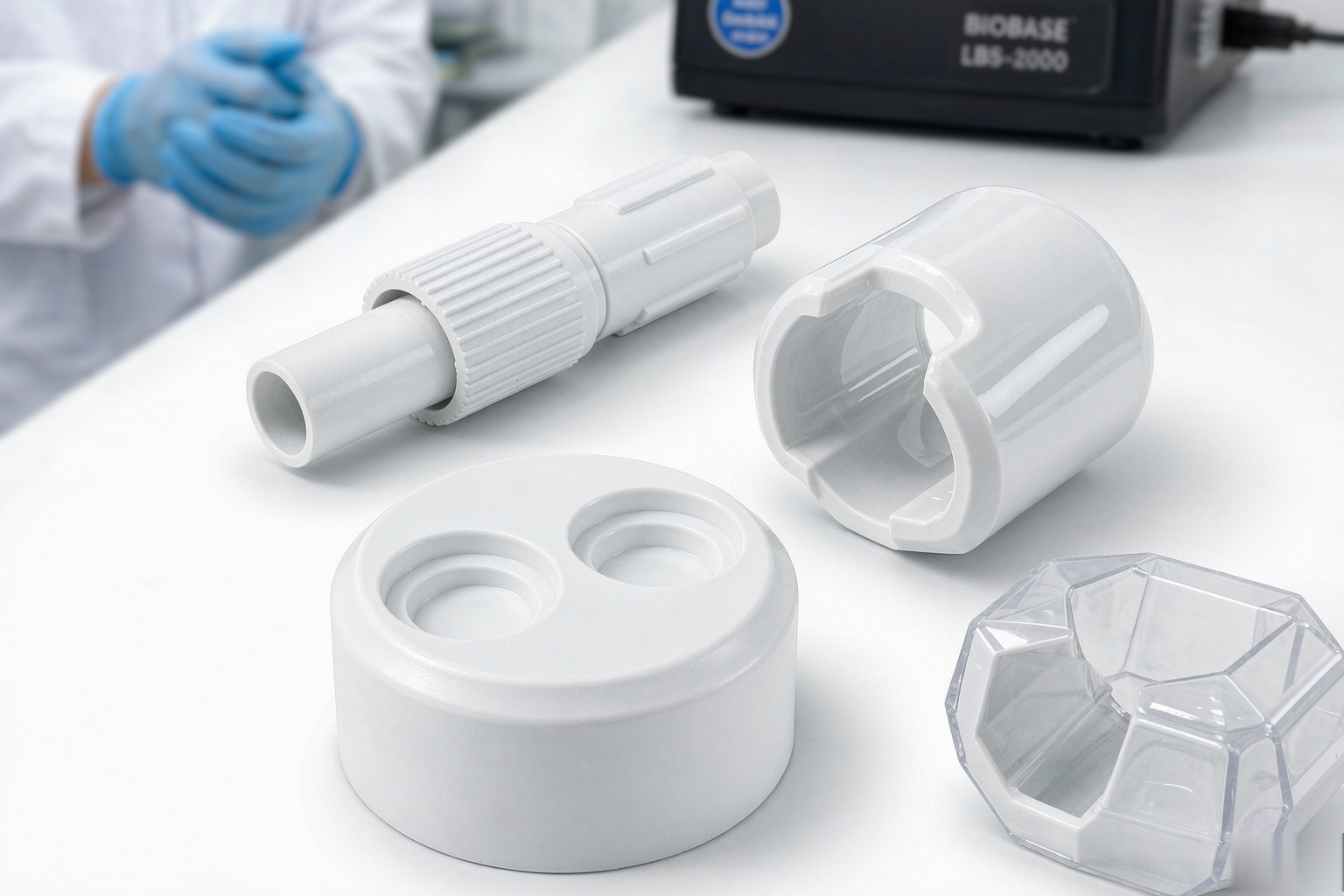
Medical Injection Molding Services
Medical injection molding asks a simple question with difficult answers: can you make the same part, to the same standard, with evidence, every single time? Device housings, diagnostic equipment components, consumables and labware all live in regulated environments where consistency and documentation matter as much as the part itself.
D-top Mould provides custom injection molding for medical device components with clean production practices, documented quality control and careful material selection. We are not a certificate-collecting middleman — we build the molds in-house and mold the parts ourselves, which means the people who control your tolerances are the same people who machined the steel. That closeness is what keeps expectations and delivery aligned.
Medical Parts We Mold
- Device housings and enclosures — diagnostic devices, monitors and handheld instruments where fit, finish and color consistency matter
- Diagnostic equipment components — cartridges, caddies, alignment parts and internal mechanisms
- Disposable consumables and labware — trays, containers, sample handling parts and single-use components
- Ergonomic grips and handles — surgical and laboratory instruments with soft-touch or textured surfaces
- Covers, caps and protective components — sealing features, sterile barriers’ outer parts and tamper-evident closures
Materials for Medical Molding
Medical part materials must survive sterilization, chemicals and repeated handling while remaining body-safe and often transparent or white. We routinely work with:
| Material | Key Strengths | Typical Medical Use |
|---|---|---|
| PC | Impact strength, transparency, heat resistance | Housings, connectors, transparent windows |
| PP | Chemical resistance, living hinges, low cost | Consumables, trays, caps, containers |
| ABS | Surface finish, processability | Device enclosures, cosmetic parts |
| PE | Chemical inertness, low friction | Fluid handling, caps and liners |
| POM | Stiffness, dimensional stability | Mechanisms, pump and valve parts |
| PA (nylon) | Strength, wear resistance | Moving components, structural clips |
| PMMA / TPV | Optical clarity / elastomeric sealing | Transparent covers / gaskets, grips |
Material selection weighs chemical resistance, sterilization compatibility (gamma, EtO, steam where relevant), impact strength and regulatory requirements. Resin certifications and lot traceability are part of every medical quotation — tell us what documentation your quality system expects and we will structure the supply around it. For a deeper resin comparison, see our material selection guide.
Cleanliness and Process Control
Medical molding is a discipline of small details: controlled material handling so lots never mix, sealed and cleaned molds before every run, documented molding parameters that do not drift between shifts, and inspection routines that catch visual defects most applications would ignore. Our medical projects follow documented process control with attention to tolerance, cleanliness and consistency — and because the mold shop is in-house, any tooling-related defect is corrected at the source instead of argued about with a subcontractor.
Quality Documentation
Regulated customers need evidence, not promises. Our medical projects are structured around documentation: material certifications with lot traceability, dimensional inspection reports against your drawing, in-process control records, and cavity identification so every sampled part can be traced to its production position. We review material certification, dimensional requirements and any specific inspection or documentation needs during quotation — so expectations are explicit before production starts, not discovered after it.
Design Support for Medical Molding
Medical parts carry design constraints that general molding does not: wall thicknesses balanced against sterilization, draft angles that keep cosmetic surfaces flawless, gate locations that hide witness marks on visible housings, and tolerances that survive autoclave or gamma exposure. Our DFM review covers all of these before steel is cut — see our DFM checklist for the methodology we apply. Where a design risks short shots or warp, we run mold flow analysis and show you the results, not just the conclusion.
Why Choose D-top Mould for Medical Molding
- In-house mold making — one team owns design, steel and process, with stable T1 results
- 12-hour quotation — engineered quotes with documentation scope included, returned within 12 hours
- Fast mold modifications — design iterations after clinical or user feedback handled quickly
- Flexible scheduling — prototype builds, pilot lots and production volumes supported
- Responsive after-sales support — mold maintenance, capacity planning and engineering support for the life of the program
Get a Medical Molding Quote in 12 Hours
Send your 2D or 3D drawings, material requirements, expected annual volume, tolerances and any specific quality or documentation needs. Our engineering team will respond with a free DFM review and a detailed quotation within 12 hours — including the material certifications and inspection scope your quality system expects. If your documentation requirements are unusual, tell us; we would rather scope it upfront than surprise you later.