


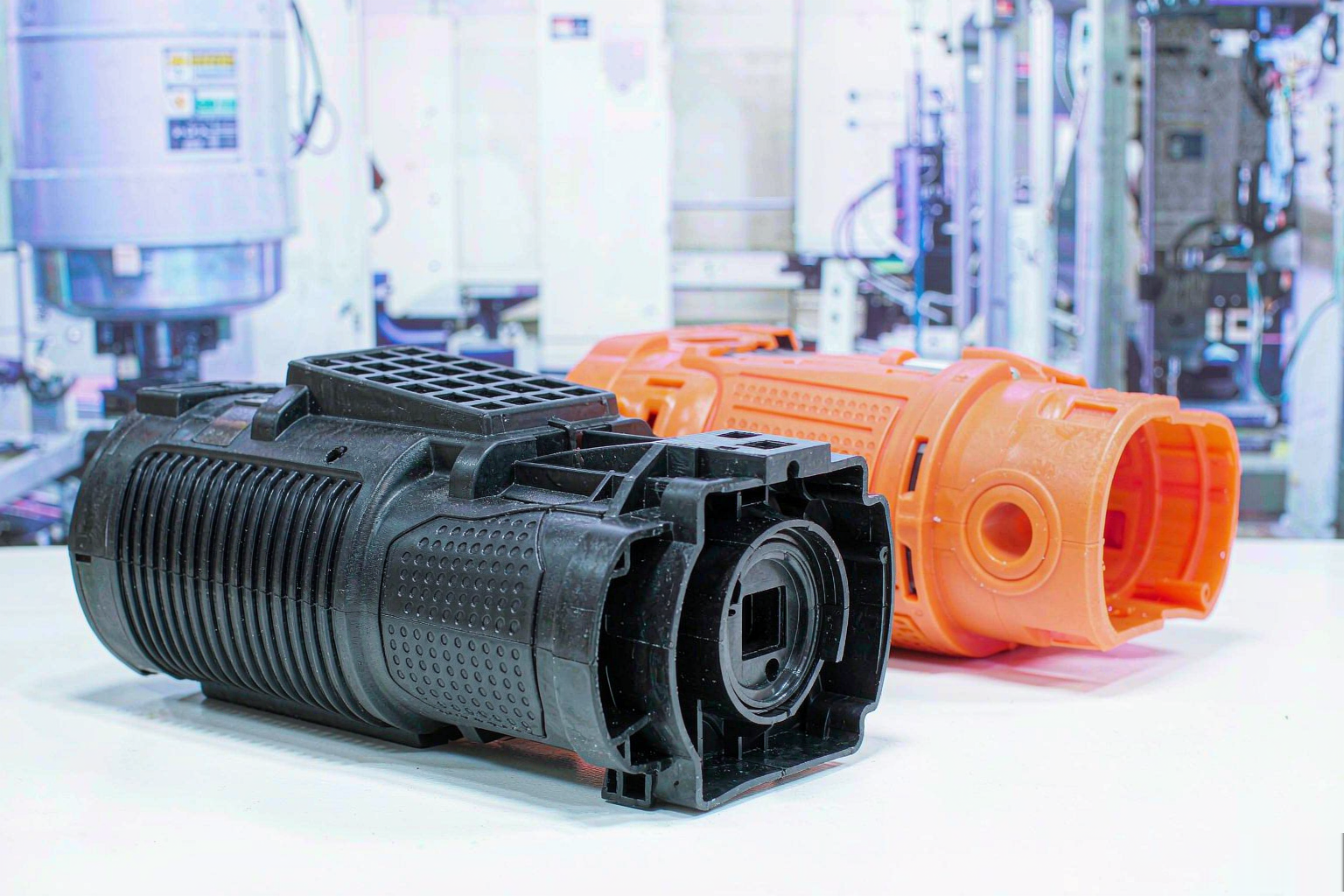
Power Tool Injection Molding Services
Power tools are some of the harshest environments a plastic part will ever face: repeated drops, torque loads, heat from motors and batteries, chemical exposure to lubricants and solvents, and years of abuse in the hands of professionals. A housing that works on a desk fails on a job site — so power tool molding is engineered for survival first and looks second.
D-top Mould manufactures custom injection molds and molded components for power tool and garden tool programs, covering housings, battery packs, internal frames and soft-grip components — from prototype builds through high-volume production.
Power Tool Parts We Mold
- Housings and gear case halves — structural shells that carry motor and gearbox loads
- Battery pack enclosures — dimensional precision for cell stacks, contacts and latch systems
- Handles and soft-grip components — overmolded or two-shot parts for grip and vibration control
- Switch and trigger components — precision internal parts with consistent actuation feel
- Tool boxes and cases — impact-resistant shells with latches and hinge features
Materials Built for Abuse
| Material | Why It Suits Power Tools | Typical Use |
|---|---|---|
| PA6-GF30 / PA66-GF30 | High stiffness, heat and impact resistance | Gear cases, structural housings |
| PC/ABS | Impact + appearance balance | Clamshell housings, battery covers |
| PP-GF | Chemical resistance, cost | Battery packs, bases |
| ABS | Finish and processability | Cosmetic shells, internals |
| TPE/TPU | Grip, vibration damping | Overmolded handles, bumpers |
For deep dives on the engineering resins behind these parts, see our material selection guide and our guide to automotive-grade molding — the material discipline is similar.
Design Challenges in Power Tool Housings
- Drop resistance — rib structures, boss design and material selection must survive repeated drops onto concrete; creep and impact data drive the DFM
- Heat from motors and batteries — continuous-use temperature limits the resin choice near motors and battery cells
- Two-material construction — soft grips over rigid shells require two-shot molding or overmolding with verified bonding
- Metal inserts — screws, bushings and contacts are encapsulated via insert molding for permanent fastening points
- Surface texture — grained finishes hide scratches and improve grip, with draft angles adjusted to the texture depth
Tolerances and Fit
Clamshell housings demand consistent parting-line control, boss alignment across mating halves and latch dimensions that survive thousands of open-close cycles. We hold functional tolerances at ±0.05–0.10 mm with disciplined process control, and dimensional reports accompany first articles so assembly fit is proven before volume production.
Tooling for High-Impact Programs
Power tool volumes justify hardened H13/S136 steels and glass-filled-compatible tooling, with hot runners on larger housings and cavitation sized to real annual volume. Glass-filled nylon is abrasive — the mold must be built for it from day one, which is exactly what our steel selection guide covers.
Why Choose D-top Mould for Power Tool Molding
- In-house tooling — design, steel, fitting and trials under one roof, with stable T1 results
- 12-hour quotation — engineered quotes with DFM flags on drop-risk features and material choices
- Fast mold modifications — fitting and balance corrections handled quickly by our own tool shop
- Flexible scheduling — prototype, pilot and production phases accommodated
- Responsive after-sales support — maintenance and capacity support across program life
Frequently Asked Questions
Q: What plastics are used for power tool housings?
A: Structural shells and gear cases most often use glass-filled nylon (PA6-GF30 or PA66-GF30); impact-resistant clamshell housings use PC/ABS; battery packs and bases use PP-GF. Soft grips use TPE or TPU, overmolded or two-shot onto the rigid shell.
Q: How do you mold a soft grip onto a power tool handle?
A: Two ways. Two-shot (2K) molding injects the rigid substrate and the soft TPE/TPU grip in one cycle for a permanent molecular bond, best at high volume. Overmolding molds the soft material onto a finished rigid part in a second operation, cheaper for lower volumes.
Q: What tolerances can power tool injection molding hold?
A: Functional features such as boss alignment, latch geometry and parting-line fit are held to ±0.05–0.10 mm with disciplined process control. Dimensional reports accompany first articles so assembly fit is proven before volume production.
Q: How do you make power tool housings survive drop tests?
A: Drop resistance comes from impact-modified nylon or PC/ABS, correct rib and boss design, generous corner radii, and keeping weld lines out of high-stress areas — all reviewed during DFM before steel is cut.
Q: How much does a power tool injection mold cost?
A: A single-cavity power tool housing mold typically ranges from roughly USD 8,000 to USD 30,000+ depending on size, cavitation, steel grade and hot runners. Multi-cavity production tools cost more. D-top Mould quotes in detail within 12 hours.
Get a Power Tool Molding Quote in 12 Hours
Send your 2D or 3D drawings, material, expected annual volume, drop-test or durability requirements and appearance standards. Our engineering team returns a free DFM review and a detailed quotation within 12 hours — flagging the features that decide whether your housing survives the job site.