


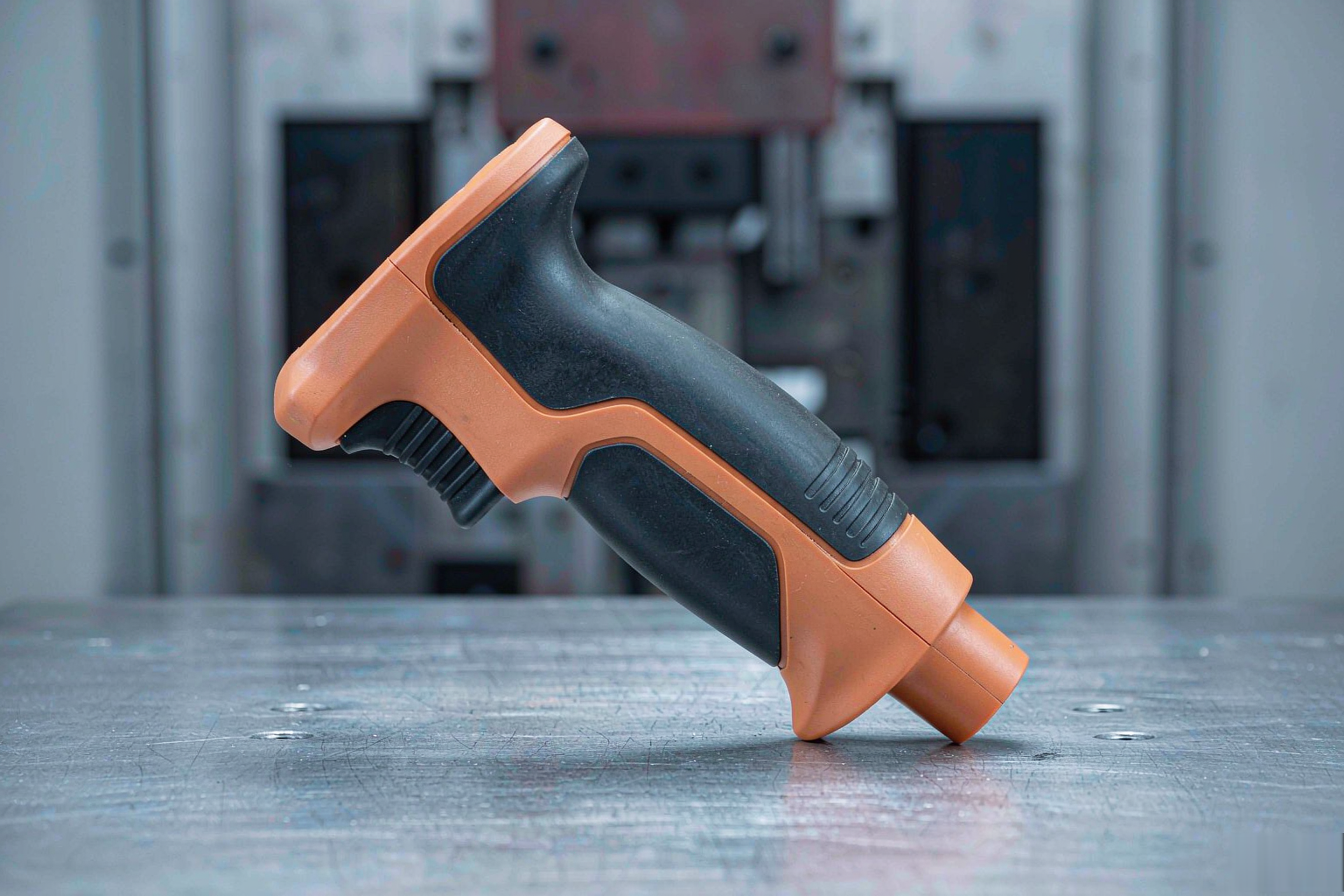
What Is Overmolding?
Overmolding is a molding process in which a rigid plastic substrate is covered with a second, usually softer material in a second molding operation. The soft material — commonly TPE or TPU — is bonded onto the rigid part to create a comfortable grip, a seal, or a protective layer. The result looks and performs like a single part, without adhesives, mechanical fasteners or assembly labor.
Beyond soft grips, overmolding solves engineering problems: vibration damping on power tools, watertight seals on enclosures, non-slip surfaces on handles, and two-tone cosmetic finishes that would otherwise need painting or pad printing.
How the Overmolding Process Works
- Substrate molding — the rigid base part is molded first, exactly as a standard injection molded part.
- Placement — substrates are loaded into a second mold, either by hand, by robot, or via a rotating platen.
- Overmold injection — the soft material is injected onto or around the substrate at a temperature that activates bonding without deforming the base part.
- Cooling and ejection — the bonded part cools and is ejected as a single finished component.
Overmolding vs Two-Shot Molding
Both processes combine two materials, but overmolding typically molds the soft layer onto a pre-molded substrate in a separate step, while two-shot molding completes both materials in one cycle. Overmolding is often more cost-effective for lower volumes and for designs where the substrate is produced separately, while two-shot molding suits higher volumes with tighter integration.
| Factor | Overmolding (secondary) | Two-shot molding |
|---|---|---|
| Mold investment | Lower | Higher (multi-station tool) |
| Best volume | Low to medium | Medium to high |
| Bond consistency | Good, handling-dependent | Excellent, fully automated |
| Design flexibility | Substrate can come from anywhere | Both shots designed together |
Not sure which route fits your volume? Our free DFM review compares the real numbers — mold investment, cycle cost and quality risk. For the deeper economics, see when two-shot molding is worth the extra cost.
Common Overmolding Applications
- Power tools — soft-grip handles and impact protection
- Consumer electronics — protective bumpers and button covers
- Medical devices — ergonomic grips and sealing surfaces
- Household products — comfortable handles and non-slip bases
- Industrial equipment — vibration dampening and protective layers
Common Material Combinations
| Rigid Substrate | Soft Overmold | Typical Pairing |
|---|---|---|
| PP | TPE / TPV | Appliance handles, seals |
| ABS | TPU / TPE | Electronics grips, bumpers |
| PC | TPE | Device grips, sealing layers |
| PA (nylon) | TPE | Tool handles, vibration parts |
The substrate material, bond strength and chemical compatibility are reviewed during DFM to ensure a durable bond between the two layers — bonding is chemistry, not luck.
Design Guidelines for Overmolding
- Design for the bond — through-holes, undercuts and grooves in the substrate give the soft layer mechanical anchoring in addition to chemical bonding.
- Mind the heat — the overmold is injected hot onto the substrate; thin substrate sections and heat-sensitive resins need careful process windows.
- Watch shrinkage mismatch — rigid and soft materials shrink differently; DFM predicts where curl or stress will appear.
- Keep soft sections thick enough to feel — but not so thick that cycle time suffers.
Overmolding at D-top Mould
D-top Mould designs and builds overmolding tools for prototype and production volumes. Our process covers DFM review, substrate tooling, overmold tooling, material pairing and trial validation — with bonding quality checked on trial parts before the mold ships. Where volumes justify it, we also support in-house robot handling of substrates for consistent placement and repeatable bonds. We support both the initial design and the optimization of existing overmolded parts, and can mold the finished parts for you as a custom plastic parts supply program.
Frequently Asked Questions
Q: What is the difference between overmolding and two-shot molding?
A: Two-shot molding forms both materials in one machine cycle using a rotating mold. Overmolding molds the soft material onto a finished rigid part in a separate operation. Overmolding has lower tooling cost; two-shot gives a stronger bond and lower per-part cost at high volume.
Q: What materials are used for overmolding?
A: The overmold is usually a soft TPE or TPU, sometimes TPV for seals, molded onto a rigid substrate such as PP, ABS, PC or nylon. Compatibility determines whether the two bond chemically or need a mechanical interlock.
Q: How much does an overmolding mold cost?
A: Overmolding tooling is generally lower than two-shot because each material runs in its own mold. A single-cavity overmolding mold often starts around USD 4,000–8,000, depending on part size, cavitation and steel grade. D-top Mould returns a detailed quote within 12 hours.
Q: Can overmolding make my product waterproof?
A: Yes — molded-in seals and gaskets can be waterproof when the substrate and overmold bond properly and the design includes sealing geometry. Molded-in seals outperform glued gaskets in immersion and drop tests.
Q: What design rules should I follow for overmolding?
A: Keep the substrate rigid enough to survive handling, design a bonding interface (chemical compatibility or an interlock), avoid overly thick overmold sections that sink, and place gates away from cosmetic surfaces.
Get an Overmolding Quote in 12 Hours
Send your 2D or 3D drawings, the substrate and overmold materials, expected annual volume and tolerance requirements. Our engineering team reviews bonding compatibility and returns a free DFM review with a detailed quotation within 12 hours — so you know the tooling cost, the cycle economics and the bonding risks before committing.